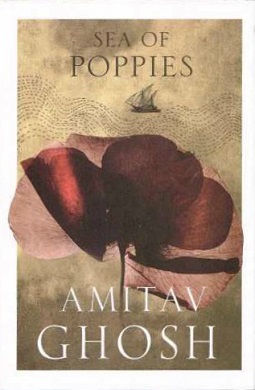
My week-long voyage to Sea of Poppies by Amitav Ghosh was full of excitement,adventure, learning and joy. Set in the historical backdrop of mid-nineteenth century the novel’s canvas is as wide as an ocean, carrying in its womb multitudes of stories, characters, themes, locations, languages…… yet remaining placid, cool and calm.
I became interested in the book after reading a reference to the opium factories in Gazipur and Patna in one of the book’s reviews. I already knew that the main building of Patna College, much before the college was started in 1863, had been used as an opium factory earlier. This led me to embark on the journey of Sea of Poppies with the expectation to sail through the history, language and culture of the places, I thought, were known to me. Flipping through the pages of the book was an exhilarating experience. I got an opportunity to observe the places like Patna, Bakhtiarpur, Monghyr, Teghra, Barauni or objects like Barh ka Lai etc through the prism of a master story teller like Amitav Ghosh.
However these are only a few of the many items available on the plate of the novel. Just as the white Ganga merges with the Hoogly and finally disappears in the Black Water of the Ocean at Gangasagar, the story continues through the regions of Bhojpur, Bengal, India, China, England, Europe(the list is long); creating in its wake the conflicts of culture, language, politics and economics, evoking in the reader sympathy, love, hate, humour and nostalgia for a bygone era.
Reading the novel is like having a smooth sail in a dinghy over the surface of a deep sea. By the way what happened to Jodu, Kalua, Serang Ali, Neel and Ah Fatt after they escaped in the lifeboat and what was in store for the rest of the characters on the ship named Ibis? I must find out in the next novel of Amitav Ghosh, River of Smoke. My next voyage has already begun.
In the second episode Prof K M Tiwary shares how he was refused admission to BA in Patna college, even though he was eligible for the same.
In this episode he throws some light on his life as a student at H D Jain College Arah. One may also get a glimpse here of the political climate of the country and the world of that time.
Me: Once you were refused admission to Patna college, where did you go for your Bachelor of Arts?
Prof Tiwary: I had no other option but to look for another college. And the only choice for me in Patna was B N College. There was no other college for Humanities in Patna back then.
Moinul Haq was the Principal of B N College. He was another interesting character. He was also the Chief of the Hockey Federation of India. Moinul Haq stadium in Patna is named after him.
I knew a student of B N College named Ganesh Shankar Vidyarthy who was a student leader of the Communist Party. Later he became a prominent leader of CPI(M). He was a few years senior to me then. He accompanied me to meet the Principal in his office for my admission.
Moinul Haq asked me, “Where had you been in I A?”
When he came to know that I was in Patna College, he said, “You should go back to Patna College because we don’t accept the students who are nerds. We admit the students who are either sportsmen or potential leaders”.
After that he narrated the story of a student of the college named Mr A P Sharma, who was an Indian Railway Union leader then. Later he became the Union Minister in the Govt of India and still later Governor of Punjab and West Bengal.
Mr Moinul Haq also shared with Ganesh Shankar Vidyarthy how he was not given a visa once to play Hockey in a Communist country while he was leading the Indian Hockey team. It was because Mr Moinul Haq and some other teachers of St Xaviour’s School Patna had been part of a committee which were sympathisers of the policies of the United States of America.
Despite these anecdotes Principal Haq didn’t agree for my admission to his college.
Me: Sir, what did you do after you were refused admission in B N College?
Prof Tiwary: When the doors for my admission were closed in Patna, I had no choice but to move to the only college in my district town, Arah, and that was H D Jain College. The principal of the college was one Prof Bhattacharya. He saw my marks and simply wrote ‘Admit’ on my application form. I was admitted.
In Arah my link with the Communist Party became stronger and my responsibilities increased. Besides attending the classes I had to represent the Party in the college and the town. I had to go to Patna once or twice a week and bring the literature, books and newspapers from the Party office for distribution in Arah town. I used to visit the other nearby towns too for the Party work.
Back then the Party had a popular newspaper, Janshakti, which was published from Patna. I used to purchase 200 copies of the newspaper from my own pocket money in Patna and sell them in Arah. Generally I would choose a Tea Shop in the marketplace or near the railway station and sit there. A Tea Shop is a place where a number of people come for tea. Some of them used to buy the newspaper. The shopkeeper knew me as a student. So he didn’t mind my sitting and selling the newspaper there. I would sell the paper to the common people who won’t necessarily be connected to the party.
Within a year of my admission a student was penalised by the college authorities. The student had not been at fault. He had become a victim of a teacher’s personal grudge against him. It was a case of injustice and I organized a protest in the College against that decision.
When I met the Principal during the protest, he said, “Are you the same student who had come from Patna College last year? Have you come here to indulge in such activities?” But he couldn’t take any action against me because the whole college was with me.
In 1951 we led another protest in the college during a conference of professors. Our demand was that the college should be closed for the first General Elections of Independent India (1951-52). A number of students wanted to do canvassing during the elections.
Those were the early days of the cold war which sought to split the world between the two blocks led by the two superpowers, the US and USSR. They would try to influence the world on every single issue like politics, economics, ideology etc and every move made by the Western Alliance led by the USA would be opposed by the Eastern Alliance represented by the USSR.
Soviet Union was then the source of the Communist movement in the world. It was the fountainhead of the Communist strategies, policies, ideas, protests, movements.
One such movement initiated by the Soviet Union to counter the US possession and stockpiling of nuclear arms was the Peace movement. USSR had not acquired the atom bombs by then and it was trying to project itself as a peace loving nation and America as a war monger. My duty as a member of the Party was to propagate and lead several such protests and movements of the Party.
In 1948 the Communist Party was banned in India after a call for armed rebellion by Mr B T Ranadive in its second congress in Kolkata. Many of its leaders had gone underground. The ban was lifted in 1951 before the First General Elections.
In the first episode Prof K M Tiwary narrated what had led to his involvement in the political activities as a student at Patna College.
In this episode he relates the story of why he could not get admission to BA (Bachelor of Arts) in Patna College despite his good results in IA (Intermediate of Arts). Here he also tells the story of his adventures of swimming across Ganga in Patna.
Me: Sir, why did you have to leave Patna College in B A?
Prof Tiwary: By the end of my Intermediate Exams I had started realising that my drift towards Communism was taking a toll on my studies and I must do something about it. So I made up my mind to move away from Patna College, known as the best in Bihar for the study of Arts then. Any other college nearby which could match its reputation was either University of Allahabad or Banaras Hindu University in Uttar Pradesh.
So immediately after the results of Intermediate I went to Allahabad, Prayagraj now, to seek admission in B A (Bachelor of Arts) there. I stayed there with a distant relative in a hostel. My results for I A were very good. I had no doubts about my getting admitted to the best college in the university. But I was disappointed to learn that the admissions had been closed. I was late. Then I moved to BHU. I had to face the same problem there too. The sessions of Allahabad and BHU were a little ahead of that of Patna University. By the time Patna declared its results, Allahabad and BHU would close their windows for admissions. So finally I had to come back disappointed to knock at the doors of Patna College once again, not knowing that even their doors had been closed for me.
On my arrival I went straight to meet the then Principal, Prof K P Sinha. I got the chit of my name sent and I was called inside.
The Principal said, “Are you K M Tiwary?” I said, “Yes Sir”
Then he said, “We don’t have any place for the likes of you.”
After that he rang the bell. His chaprasi came and I had no choice except to leave his room. I was pretty upset by the Principal’s response.
I realised that the Principal had received an adverse report from the hostel authorities about my activism in the college and the university. He refused to admit me probably because of my affiliations to the Communist Party.
The Principal of Patna College used to live in the Principal’s residence in the campus. The hostels like Jackson and Minto were in the same campus, about 100 meters away from the Principal’s residence. The best students in the merit list would be allotted Jackson Hostel. After that they would be provided accommodation in Minto. I had secured very good marks in the Matriculation Board Exams. So I had been a boarder of Jackson Hostel.
The Principal, of course, was at the top in the hierarchy of the hostel administration. Below him was a warden, who would be a senior teacher of the college, to oversee all the hostels. Each hostel then would have a superintendent to take care of the respective hostel. The residence of the superintendent was attached to the hostel. Moreover there were assistants under the superintendent to monitor the day to day affairs of the hostel. Those assistants were known then as ward servants. Very often those ward servants would spy on the activities of the students and share the reports to the superintendents.
The superintendent of the hostel would take a round of the hostel once in a while but the ward servants would be on duty round the clock. There were different schedules for the mess, study hours etc in the hostel. In the night the lights would be off after 11 pm, by which we were supposed to be in bed for sleep.
Once I recall a ward servant was on a round. He came to my room to see if I was present or not. I was away from the hostel but I had arranged the bed in such a way that it appeared that somebody was sleeping there. I had covered my pillow with the quilt properly to hoodwink the ward servant. But he already had some prior information of my absence. He pulled the quilt and discovered that I was not in the bed. Immediately he reported the matter to the superintendent.
Next morning I was called by the superintendent and asked to explain why I had been absent from the hostel the previous night. The superintendent also inquired about my activities and affiliations with the Communist Party and cautioned me not to participate in such activities further.
Those were the years after the Independence in India when the Congress Party was in absolute power in the country and also in Bihar. Communist Party was emerging as an aggressive opposition in the state. So the authorities kept a strict vigil on the activities of the Communists. Later the Party was banned in Bihar for some time and its leaders were put in jail.
Once I remember that some AISF students of Patna College hostels were participating in a protest outside the college, in the city, and they were arrested. During the same period some unknown persons had set the old gymnasium building in Patna College on fire. The police of the local police station, Pirbahore Thana, then linked that incident of fire with the protest by the Communists and accused the boarders who had been arrested in the city of arson. I had nothing to do with that particular protest though.
Still the hostel authorities had been aware of my involvement in what they would consider the illegal political activities of the Communist Party. My occasional absence from the hostel to attend the Party meetings had come to their notice. And it was in this background that I was refused admission in BA at Patna College.
Me: Please share the story of how you swam across the river Ganga in Patna?
Prof Tiwary: Another incident had taken place in 1948 while I had just joined Jackson Hostel in first year(I A). One afternoon I went to the Patna College Ghat, popularly known as Batheja Ghat, along with one of my friends from Arah Zila School. We both decided to swim across the river Ganga.
I hail from a village named Nainijor which is on the bank of Ganga and where it was common for the youngsters like us to cross the river. We were confident we could do that in Patna too. We didn’t realise that the river’s bed becomes much wider at Patna because of the two tributaries, Sone and Gandak, that join Ganga just before. The current also is higher. By all means it was a very wild decision to swim across the river.
We both embarked on our swimming mission out of mere impulse. We started together but I overtook my friend soon. When I reached the middle of the river, I looked back and saw that my friend had suddenly decided to return. He was actually tired. But his decision to turn back could have been dangerous because a large ship carrying passengers from Mahendru Ghat to Pahleja Ghat was getting very close to him. He escaped being caught in the range of the ship by just a few seconds. I, on the other hand, kept the spirit and speed and continued swimming. Towards the end I was also getting exhausted. When I reached the other side, the people there asked me where I had come from. They were amazed to hear that I had come from Patna College Ghat because I had not been swept away by the high current of the river as much as I should have been. It is almost impossible for anyone to cross a river like Ganga straight. Normally you would be swept at least a kilometer or so diagonally to the other bank by the waves. My diagonal distance was much less.
By the time I returned back to Batheja Ghat it was dark and my friends had already gone out in search of me by boat. I disembarked from a boat in what you would call the undergarments that I used to wear then. They were fully wet, clung to my body. The teachers of the college were having a party on campus then and I had to wade through the celebrations to go to the hostel. No wonder the word got around my crossing the river in the campus soon. The authorities’ decision to refuse me admission in B A was not linked to this incident though. It had happened a year or so earlier.
Much later when I became a lecturer I swam across Ganga once again. It must have been sometime in the late fifties. It was the same Ghat of Patna College. Dr R K Sinha, the Head of the English department, had accompanied us by a small boat generally known as Dengi. I along with another colleague (I don’t remember his name. He was also from Bhojpur region) had crossed the river swimming. It was a planned event and we had had fun. Dr Sinha had taken what we call as Sun Bath on the sand on the opposite bank of the river.
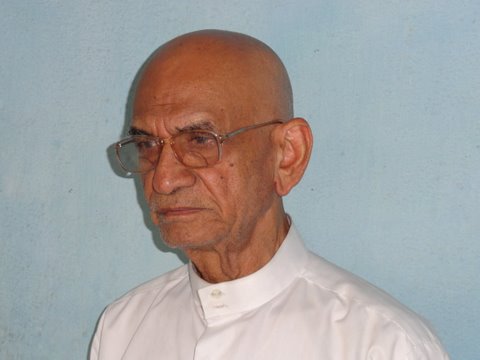
Dr Kapil Muni Tiwary was an eminent linguist who had worked as a professor of Linguistics and English literature at the universities in India, the Republic of Yemenand in Iraq for more than 50 years. He passed away on 26 April 2021.
A scholar of English, Sanskrit, Arabic, Persian and several South Asian languages including Hindi and Bhojpuri, Dr Tiwary had completed his PhD in Linguistics under the supervision of an internationally acclaimed indologist, Prof George Caradona in the sixties. The subject of his thesis was Panini’s description of Sanskrit nominal compounds. He carried out some path breaking research in Descriptive and Socio- Linguistics. Many of his papers were published in well-known international journals.
In a series of interviews that I conducted in 2019 he shared the experiences of his life and times as a student and as a teacher. In the following episode he relates the story of how he got exposed to the political activities as a student in Patna University. One may also peep into the political climate of the university, immediately after independence.
Me: Sir, how did you get exposed to the political activities as a student in Patna university?
Prof Tiwary: In 1948 I enrolled as a student of I A (Intermediate of Arts) in Patna College. I was fresh from school, having no idea of what a college is, what the atmosphere was like etc. Zila School Arah, from where I had come, had strict discipline. You had to follow the rules or face the music in the school. A student like me, who was good in studies, hardly had the scope for any violations. So when I joined the College I felt I had been released from a cage.
Patna College then was considered as the oldest and the best college for Humanities in Bihar. This 150 year college was known not just for its heritage Dutch buildings and the sprawling, beautiful campus on the bank of Ganga but also for its alumni and professors.
Soon after I joined Patna College there was a strike in the university for the abolition of Test. You had to take a test in those days before you were allowed to take the Final Examinations. It was known as the Pr-Final Test. You could appear in the Finals only after you had cleared that Test. One of the student leaders who were spearheading the protest was P N Sharma who became a professor and later Principal of Vanijya Mahavidyalaya at Patna University. P N Sharma was a student of fifth year MA(Master of Arts) then. Another student leader named Janu Prasad wanted a complete overhaul of the Examination system in the university. When he spoke about the reforms in the Exam system, we listened to him with rapt attention.
That strike continued for many days. It led the authorities to shut down the colleges for a month and the students were sent home.
We, the students of the first year, were innocent. For us everything in the college was new. We did not know what Test was about or the strike was about. The protests were being organised by the students from the senior classes. It was they who held the public meetings. But we found the idea of change pleaded by them exciting. We would encourage them by listening, clapping and saying Zindabad. Nothing more. Little did I know that what had come to me as fun was soon going to take me in its grip in due course.
The protest against the Test in the university took place in 1948, only a year after India’s independence. Congress at that time was the strongest political party in the country. The student wing of Congress was, and still is, NSUI (National Students Union of India), which was quite powerful and active in the universities. Communist Party of India was just making its foothold in Indian politics. It was trying to make inroads into the students through its student body, AISF (All India Student Federation).
The protest against Test had nothing to do with party politics. It had actually been initiated by the students as an expression of their resistance against the existing examination system. But I was not aware that AISF was looking for such moments of resistance from the students in the university. They had been watching the event very closely.
They soon grabbed it as an opportunity to strengthen their base. They identified the students who were cheering or supporting the leaders in the public meetings and started inviting them to their regular meetings. I, being a part of the Students’ group from Arah District, started attending the meetings out of curiosity.
A few months later, there was a move on the part of the university to increase the examination fee by 5 rupees and AISF decided to protest. A meeting was going to take place in Wheeler Senate Hall of the university to approve the proposal for the increase. The meeting was to be attended by the teachers, officials, the Vice-Chancellor and others. All India Student Federation decided to protest against the proposal of the hike.
Wheeler Senate Hall, as you would know, is an imposing building facing Ashok Rajpath in Patna. It was built to host the university meetings, convocations and other functions during the British period. The hall was constructed at a cost of Rupees 1.75 lakhs, which Raja Devaki Nandan Prasad Singh of Munger had agreed to bear then. It was inaugurated by the then Governor of Bihar and Orissa Province and Chancellor of the University, Sir Henry Wheeler in 1926. So it was named Wheeler Senate Hall. While passing through Ashok Rajpath you can’t miss the large structure of the hall with its huge pillars in the front. The hall is situated at a height for which you have to climb stairs.
While the meeting of the Fee Committee was going on, a group of about 20 AISF students ascended the stairs and started shouting slogans to withdraw the proposal for the hike. I was one of them. It was my first experience of being in the forefront of a protest. Among others there was a daughter of Mr Dutta, a professor of Philosophy. There was also a daughter of another professor in the university.
I shiver to think even now how dangerous it could have been for us. We faced initial resistance at the main gate. A group of people had been deputed by the university authorities to block our entry to the hall. It led to some pushing and pulling from both sides. We were being pushed from inside and anyone of us could have been pushed below on the ground and would have broken his neck, nose or head. Anyway we kept on shouting slogans and managed to enter the hall.
We must have continued shouting for a few more minutes when the situation became more precarious. Suddenly a large group of students entered the hall from another side and the front gate was closed from inside. These students had been called by the university authorities to the venue to counter our protest. They were the members of NSUI, the Congress supported student body. They were larger in number, almost double or triple of our own. Soon sloganeering and counter sloganeering started from both sides.
We were saying, “छोड़ो बाप को, हटाओ फीस वृद्धि “, which meant, forget the father, withdraw the hike.
One of the students in our group was the younger brother of Chandrashekhar Singh, a prominent youth leader of the Communist Party in those days. He was two years senior to me in college. Their father, Shree Ramcharitra Singh himself was a famous leader of Congress party, a Cabinet Minister in the Government of Bihar then and it was he who was presiding over the meeting as a member of the University Senate.
Both the father and the son were present in the hall, the former was leading the authorities for the hike and the son was protesting against it. And so the slogan, छोड़ो बाप को, Forget the father.
The NSUI students were even louder. They were saying,
“कम्युनिस्ट गुंडों को मारो ”, Attack the Communist goons.
Both the groups came face to face with each other for a while, shouting slogans. Then it became physical. Our group was small and we were at a disadvantage. The other group started hitting and pushing us down. We could have been crushed in the pandemonium. It was becoming violent. With a lot of difficulty we were able to escape. It was very scary.
Much later Prof P N Sharma once said to me, “You remember the protest in which you had participated then. I had saved you people. You could have been beaten to death.” He was one of the student leaders of NSUI who had come on behalf of the authorities on that day.
Most of the students who had joined the protest did not know much about the Communist ideology. We were innocent. But we did like the way the student leaders of AISF spoke against injustice. We also liked their idea of equality. We didn’t know, at least I didn’t know that the protests like these were part of a larger battle that was going on between the Congress and the Communists to seize the political space at the state and national level.
I kept attending the meetings of AISF and the Communist party frequently. I would listen to the speeches of the leaders and read the literature. My initiation into the Party had begun without my being aware of that. I became one of their recruits and my name was on their list on which the State Intelligence Department lay its hands later. It was keeping a close eye on the activities of the Communists in the university.
In this episode Prof Kapil Muni Tiwary shares the story of how he got the opportunity to study in the University of Pennsylvania, one of the top universities of the US, in the mid sixties for his PhD in Linguistics. It throws some light on the political changes that were taking place in Bihar in 1961. It also describes the appointment of Dr George Jacob as the new Vice-chancellor of Patna University. Dr Jacob proved to be one of the most competent Vice-Chancellors of the university after Indian independence.
Me: Could you share the story of how you went to the US for higher studies?
Prof Tiwary: In 1961 Dr Shri Krishna Sinha, the then chief minister of Bihar, died. After a good deal of politicking in Congress party Shri Binodanand Jha, a senior leader of the party, took over as the second Chief Minister. That led to several changes in the administration and bureaucracy all over the state.
A senior civil servant named Dr George Jacob became the new Vice Chancellor of Patna University. He had been a teacher of English at Patna University sometime in 1948. Later he had joined Indian Civil Service and had risen to the rank of Commissioner in Bihar. Those days there were no written exams for IAS and other civil services. People were generally selected through interviews.
When Pandit Binodanand Jha became the chief minister, George Jacob was the commissioner of Bhagalpur. Binodanand Jha was also from Bhagalpur, so he knew him well.
Since George Jacob had worked in Patna university in the past, many people knew him. So when he took over as VC, the teachers of the university, many of those who had been his colleagues, invited him to tea in the evening. The venue was the campus of the university and a number of senior teachers were there to welcome him. I, a young lecturer, was also present.
In his speech Mr Jacob encouraged the faculty to do their job in the best possible manner. He promised all kinds of help and support. Though his tone was authoritative, he seemed quite supportive of the teachers.
The teachers appeared by and large convinced by his words. The teachers like Prof P N Sharma knew him from before. George Jacob also knew them. They had worked together in the past. They could connect with him easily.
Dr Jacob further continued, “As an IAS (Indian Administrative Service) officer I have administered the districts and commissionaries well, as a VC also I hope to do the same.”
Like a civil servant he added, “I mean business.”
Dr Radha Krishna Sinha, better known in the university as Dr Sinha, the HOD of English, was not present in the meeting. He was not very friendly with the mob, the teaching mob. Usually in the evening he would stay at home and chat with his friends. I went to him the next evening. I was excited about the new Vice Chancellor and his promises. So I shared my excitement with Dr Sinha.
Dr Sinha said, “What did he say?”
I blurted out the assurances that George Jacob had made the previous evening.
Dr Sinha then inquired, “Does he mean business?”
“Yes, that is what VC Jacob said. He means business” I said.
I added that he had promised to do all he could to set new standards in the university.
At this Dr Sinha said, “There is nothing new in what he has said. Every new VC says that when he joins but the university has remained the same.”
Prof Chetkar Jha, a senior faculty of Political Science, was sitting there. Usually he would be at Dr Sinha’s residence in the evening. There was another teacher from the Psychology department. His name was Prof A K P Sinha. All the three were quite senior to me. I was the junior most lecturer among them. Dr Sinha had been my teacher.
Pro Jha interrupted, “मिलें हैं? आप उनसे मिले हैं? Have you met him?
I said, “No, I haven’t met him.”
He added, “मि लि ए, फिर कोई राय बनाइये।” First you meet, then form opinions.
He cautioned me not to form opinions about the new VC without meeting and interacting with him. He spoke in his sharp Maithili tone. Chetkar Jha’s drawling voice kept ringing in my ears long after I left the place.
The next day I was going to Patna College to take the Honours classes. I used to live in the teachers’ quarters at Rani Ghat in those days. On the way I would go to Patna Science College to take the classes and from there I had to cross the University campus to reach Patna College.
Coming from Science College generally I would enter Patna University campus from its eastern gate. Taking a round of the university office I would emerge from the western gate, exactly in front of Faraday Hostel.
The VC’s office was on the ground floor, very close to the western gate. That day just as I was about to come out of the university campus from its western gate, I turned to the VC’s office. I decided to meet him. I got the chit with my name and other details sent inside. And I was called.
George Jacob said with a hump in his voice, “What can I do for you?”
I reminded him of the words, “I mean business,” he had spoken in the meeting.
“Yes, I said that. I do mean business. What is your business here?” he boomed out.
With a little hesitation, I spoke the words I had come prepared with.
“I would like you to recommend my application for a scholarship for higher studies abroad.” I mumbled.
“Where do you want to study?” he probed.
I said, “Moscow, at the Institute of Linguistics”
I told him that the Institute was very well-known in the world for Linguistics. But he encouraged me to go to the USA, rather than to Moscow for higher studies.
Further he said, “But before I do it, I would like to know you more.”
Suddenly it came to my mind that instead of leaving the matter to other teachers to give him the feedback about me, I should request him to visit my class.
So I invited him to come to my class.
I said, “Sir, whenever you are free, you can see my class.”
I gave him the details of my periods in Patna College and also in the postgraduate department.
“In order to recommend your application for scholarship, I need to know you at least for two years.” he concluded.
I thanked him and left the room.
VC Jacob did turn up at my class soon after. It was the honours class at Patna College though.
As soon as he entered the class, the bell rang for dismissal. Seeing the Vice Chancellor, the students rose and greeted him in unison. I couldn’t understand what had happened. Why had the students risen? When I turned to the door, I saw Dr George Jacob standing.
I asked him if I should continue.
He said, “No, that’s alright.”
And he left the class.
I went to him after some time to hand him over a paper that I had written. If I recall the title of the paper was Reading Poetry. It was later published in the Patna College magazine. After I had come back from Pune I would often write papers on Literature and Linguistics.
George Jacob looked at the paper and asked me to come after some time.
I did go to him after a week. He said he was not competent enough to judge the quality of my papers. Because the paper was related to Linguistics. Still he encouraged me to keep on writing.
He always encouraged new ideas of the teachers and welcomed their initiatives for attending conferences, writing or their efforts to enhance their qualifications and competence. Of course he knew many of them from before. He had his own opinions about them. But I was a new character.
After that I left his office. And that is where the matter stood for sometime.
Later I went to him with an advertisement for the Fulbright scholarship for higher studies in the USA. He encouraged me for that and wrote the recommendation letter, which he got sent to the Fullbright committee in Kolkata through the university.
I had to go to Kolkata to appear in the written test conducted by the Fullbright people. After passing the test I appeared in the interview. And finally I was selected for the Fulbright.
I left for University of Pennsylvania USA in 1964. And I owe it to George Jacob for that.
There was another teacher of English at B N College who had got the scholarship for higher studies to London with the help of George Jacob. His name was Prof S K Verma.
Verma had been a student of Dr Jacob at Patna College.
On his return from London S K Verma left Patna University. He joined Central Institute of English at Hyderabad. When the institute became a university, he became the first Vice Chancellor of what is known today as The English and Foreign Languages University .
By the time I came back from the US, VC Jacob had moved away from Patna. He had become the Vice Chancellor of Ranchi Unviversity. Subsequently he became the VC of University of Kerala and then the Chairman of the University Grants Commission (1973-74).
Once I had been to Trivandram to attend a conference organised by the University of Kerala. I was walking down a street with a professor of the university. Suddenly a car stopped by our side and the person in the driving seat waved at us. I was pleasantly surprised to see that it was none other than Dr George Jacob. At that time he was the Vice Chancellor of the University. As usual I greeted him.
He said, “What are you doing here?”
I said, “ Sir, I have come here to attend a conference.”He then advised the professor accompanying me to take good care of me. He also asked me to meet him before I leave Trivandram.
“Why don’t you try your hand at Wikipedia”, my teacher asked me in 2009. Wikipedia was 8 years old then. It had already raced ahead of its print counterparts like Encyclopedia Britannica or Americana in terms of volume and popularity. I was only a user of this knowledge platform, unaware that I could also become a contributor. The teacher here was the same under whom I had honed my skill of writing and research and who used to encourage me for such activities from time to time.
I took the plunge and began my journey as a writer or what Wikipedia calls as editor. My first edit appeared in September 2009. Since then I may not have made a significant contribution in terms of volume (about a thousand edits and 10 articles) but it has been an enriching experience as a researcher, writer and editor.
Today when it has turned 20, it is proper to look at this movement called Wikipedia. It is also important to understand why more and more people from different parts of the world should join it.
What is Wikipedia?
Wikipedia is a free online encyclopedia started by Jimmy Wales and Larry Sanger on 15 January 2001. The idea was to develop an online encyclopedia according to what Rick Gates had proposed in 1993 and what Richard Stallman had propagated, ‘free-as-in-freedom’, in December 2000.
Wiki was first launched as a feeder project for Wales-founded Nupedia, which was a free online encyclopedia run by only expert editors under some strict guidelines. Nupedia was founded in 2000 but its progress was so slow that only 12 articles were published in a period of one year. So a need was felt to start a project that could accelerate the pace of writing for Nupedia. It was in this context that Wikipedia came into being. Wiki is a Hawaiian word which means “to hurry, fast, quick” The growth of Wikipedia was so fast that it soon overtook its predecessor and emerged as a brand in itself. It had opened the floodgates for the community to write, edit, create.
Wikipedia became a hit soon after its launch in 2001 and it became the most important knowledge resource in the world, being used by students, journalists, and even academicians in due course. Now when it has turned 20 it has become a kind of phenomenon. According to an article published by BBC on 15 January 2021 (interestingly the source is Wikipedia itself) it has 56 million articles, 3 billion edits, 1.7 billion unique visitors a month, available in 316 languages. Another recent article published in The Guardian mentions, “It is the 13th most popular website on the internet, according to Amazon’s monitoring site, Alexa Internet, and the only one in the top 50 to be run on an entirely non-commercial basis”.
In 2001 when Wikipedia was started, it was being supported by a non-profit organisation named Bomis. Jimmy Wales was one of the founders of Bomis. Since 2003 its owner is an organisation called Wikimedia Foundation that runs entirely on charity. Each year Wikimedia Foundation makes an appeal to its readers to donate. As soon as it receives the target money for the year, it closes its doors for donations.
Initially Wikipedia was its only project but now there are eleven such projects being supported by Wikimedia Foundation: Wiktionary for words, Wikimedia Commons for media files, Wikibooks, Wikiquote, Wikisource, Wikiversity, Wikispecies, Wikivoyage, Wikinews, Wikidata & Wikipedia. The main goal of all these projects is to disseminate human knowledge by following the free content model.
Controversies
Since its inception Wikipedia has had its fair share of controversies. Involving the community for writing has been its major strength and the same has proved to be its major weakness on a number of occasions. Alex Hern, The Guardian’s UK Technology editor writes that when it was celebrating its fifth anniversary, in 2006, it became the subject of mockery in the mainstream press for its article on David Beckham. The article said, “David Beckham was a Chinese goalkeeper in the 18th century”. It became a “comedy of errors”. Also a case of vandalism that was fixed in 11 minutes. The article on David Beckham is one of the many that are ‘semi-protected’. The semi-protected articles can be edited only by registered users on Wikipedia. A list of Wikipedia controversies is available on its own site, here.
Reliability and accuracy
Despite the odds Wikipedia has played a stellar role in knowledge creation or its equitable distribution in the world. In 2005 a comparison was made by scholars between Encyclopedia Britannica and Wikipedia by collecting 40 articles on Science from each. An average of three errors were found in Britannica and four in Wikipedia, a comparable level of accuracy.
Katherine Mehar, the Executive Director of Wikimedia Foundation, mentions that “a YouGov poll from 2014 found Wikipedia to be more trusted in the UK than BBC.” She is not pleased with this scenario though. She says, “If there is a trust deficit in the sources that we rely on then ultimately that deficit will catch up with us as well”.
YouTube’s CEO Susan Wojcicki “announced recently that the video site will henceforth will use excerpts from Wikipedia to counteract the videos promoting conspiracy theories.” What an irony! YouTube, one of the giants in the corporate world will depend on a volunteer-run platform like Wikipedia to fact check the information.
Need for diversity
Wikipedia has several outstanding achievements to its credit over a period of 20 years. However it is facing a major challenge even today. Its community is very far from being diverse. A recent Wikimedia Foundation survey has revealed that “about 91% of its editors are male and 77% are white. As of late 2019, only 18% of the biographies are about women. Far fewer than that are about non-whites.” Though Wikipedia’s English edition has more than 31000 editors, 11 other language editions have just over a 1000. Half of the language editions have less than 10.
All these figures reflect how there is a dire need for diversity in the Wikipedia community. Editors are required for many languages other than English. A better representation is expected from the Asian and African countries. The scenario in the Indian languages is not that great. Among the Indian languages, by the way, Oriya and Punjabi are doing relatively better than Hindi.
It is not that the policy makers of Wikimedia Foundation are unaware of this. They are aware and they are taking the initiatives to fix the issue. But unless the users wake up to the call to join the movement, the improvement is not possible.
Joining the community of Wikipedia has several benefits that are personal. One gets the opportunity to write, edit, create, collaborate etc. One also acquires the skills of research and critical thinking. But beyond all this one also gets the opportunity to work for a cause that is for humanity. A cause for the knowledge that is free and is intended to be equitable.
And finally why just be a user? Why not become a contributor and try to make it better and better, with whatever one can.
A few tips about editing
Anyone can write for Wikipedia in any major language of the world, by following the guidelines available on its site. One may make edits of spelling, grammar or update the facts in the existing articles. One may also create a new article. But it is advisable to begin by editing the existing ones first. While adding the contents one must bear in mind that the contents are reliable and verifiable. Suitable references are required to support these contents. Before deciding to create an article on a subject one should also make sure that the subject is notable and it has received enough coverage in books, media etc. Otherwise the proposal for the new article may not be accepted. Biographies of living persons are not accepted easily. But Wikipedia seems biased in favour of institutions.
You might all wonder who is this guy and what is he up to? Is he here to teach and preach on Humour in the Classroom or is he going to create some humour in this classroom too? Let me assure you that I shall keep my own teaching or even preaching to the minimum. As far as the humour in this classroom is concerned? No. That is not the aim of this post.
My aim is to reveal how humour can be created in the classroom with the help of two videos: one from a movie and the other of a well-known teacher. I would also share the insights of some practising teachers in addition to my own.
A classroom is a mini world where humour exists in the form of students’ smiles, giggles, laughter, pranks etc. A lot of these happen in the absence of the teacher. Rather the teacher may himself be the subject of such humour, without his being aware of that. But we are not going to discuss them here. We’ll reserve them for some other day. Our focus today is on the teacher driven humour in the classroom. The one that is in alignment with the objectives of learning. And for which the teacher determines the distance, volume and direction.
Two classrooms: a virtual & a real
Let’s begin the discussion with a video from a popular Hindi movie by Amir Khan. Enjoy watching:
Courtesy: T-Series
This video has a classroom scene from the movie, Taare Zameen Par, in which the teacher, Amir Khan, makes a sudden appearance as a clown with all his costume and other props. The objectives of the teacher here are to introduce himself to the students (8-10 year old) of the class, engage with them and finally prepare them to learn his subject, that is Painting. He achieves these objectives successfully by his singing, dancing, acting, costume as well as by the timing and manner of his appearance. The key to this entire show, however, lies in the humor employed by the teacher in the classroom.
What is the source of humour in Amir’s classroom? How is he able to create humour? My immediate answer is: Incongruity, thou art the source of humour! Amir creates humour through various incongruous situations in the classroom.
A typical teacher is expected to dress formally in the classroom. Amir arrives here as a clown. A teacher is expected to be serious in the class like the Principal in his other movie, Three Idiots. But here he dances and romps around. His comparing a tree with a person, his descriptions of the sun, rain or the stars or even his tongue-twisters are the other examples of incongruities/oddities in the video. The students had not seen such a scene earlier in the class. They are amused to see a teacher in this new avatar. And the result is an immediate rapport between the teacher and the taught.
I agree that a classroom in a movie cannot be compared with that in real life. The primary aim of a movie is to entertain, and not to teach or educate. A real classroom, however, is meant for learning. The main aim of a teacher there is to help the students learn. Despite the differences humour may be common to both. In the former humour can add to the entertainment, while in the latter it can aid learning.
Let’s now enter a real classroom of a super teacher, Dr V S Ravindran, who by profession is a child psychologist. But I would like to cite him here as a teacher who is effective in reaching out to his students. And the key to his skill lies in humour. Dr Ravindran is a living example of humour in the classroom. He can make a boring topic like Discipline in today’s schools lively and enjoyable. Besides learning, the audience gets peals of laughter as a bonus. I am sharing a video below in which he is speaking to the educators about the attraction between boys and girls. Listen to him carefully and enjoy:
Courtesy: DR V S Ravindran, ICTRC
In the video Dr Ravindran begins with a typical query from a teacher, which is followed by his answer:
Teacher: Boys and girls having attraction towards each other. हमको क्या करना चाहिए? (What should we do?)
Dr Ravindran: हमको कुछ नहीं करना चाहिए। जो करना है, वो दोनों करेंगे। (We should not do anything. Whatever has to be done, will be done the boy and the girl.)
His answer to the query is the gem of a trigger for laughter with which he sets the tone for his presentation right in the beginning. Dr Ravindran uses such triggers one after the other in his presentations. And as soon as the educators open their mouths for laughter, he puts the chunks of learning for them to swallow and digest. A number of such videos by Dr Ravindran are available on YouTube. One may observe his techniques like wordplay, ambiguity, punchlines, playacting, variations of tone etc.
Personally I have had the privilege of attending some of Dr Ravindran’s lectures. I did try to integrate some of his techniques in my classroom. I learned to use humour also from another popular counselor based in Delhi named Mr Jitin Chawla. His presentations are again a big hit among the students in schools. In a recent conversation he shared with me that earlier he used to focus merely on delivering the contents in his lectures. But when he observed the speeches of Dr Ravindran he realised the need to infuse humour in them.
The two videos shared above are only the samples to reveal how humour can be created in the classroom. But they are not the final words on the topic. This is also not to suggest that a teacher should always generate laughter and mirth in the class. One may take some ideas from these and devise one’s own method and style to make the process of learning enjoyable for the students.
What do the teachers say?
I sent a questionnaire to a select group of teachers on this topic. One of them objected to the use of humour saying, “Humour in the classroom? O my God! How can you even think of that?”. According to him, a classroom is a solemn place, which should be miles away from humour. However the rest of them concurred that humour should be used as a tool in the process of teaching-learning.
I am sharing below some of the inputs/anecdotes that I received in response to my questions:
Dr Tarun Kumar, Prof & HOD of Hindi at Patna University says,
“कक्षा में हास्य का होना जरूरी है पर ये विषय से सहज-स्वाभाविक रूप से जुड़ा हुआ हो, उसे सुबोध-सुगम बनाने वाला, अलग से comic relief के लिए नहीं। अनायास लगना चाहिए, सायास-आरोपित नहीं”
Mr Chetan Joshi, an acclaimed flautist and teacher of Hindustani classical music, says that when he introduces a Raga like गोरख कल्याण to his students he begins by saying,
“जिस तरह गुलाबजामुन में न तो गुलाब है ना जामुन, कश्मीरीमिर्च में भी न कश्मीर है न मिर्च उसी तरह राग गोरखकल्याण में न तो गोरख है न ही कल्याण”
Ms Gayatri Morris, Vice Principal, Global India International School Ahmedabad, insists that just playing with words is not enough. It should be used at the right moment and in the right manner. She shares an anecdote in this regard:
“Once I happened to enter the classroom and found my students in a boisterous mood as they had been just told about the upcoming educational tour. I immediately wrote on the blackboard: Thank you for being quiet! I heard a few chuckles in response and I immediately had their attention.”
Mr Nishesh Kumar Sinha, a well-known Educationist from Ahmedabad adds, “Humour eases the learning process and helps the students learn things in a better way”.
According to Mr Mrityunjay Kumar, a technocrat and educationist from Hyderabad, “One should understand the fine balance between being humourous and being insensitive/disrespectful. If the class hasn’t been groomed to use humour as a tool, it can backfire and reduce the dignity of the classroom, and sometimes the class teachers”
Ms Manju Arif, Principal, DPS North Bengaluru writes, “While using Humour the teacher has to be mindful of the language, context and sentiments of the stakeholders.”
Ms Meenakshi Choudhary, a seasoned Biology teacher, gives an example of how she tells the students that the heart has nothing to with feelings. It doesn’t fall or rise in love. Feelings are, in fact, associated with brain. And the poor organ, heart, is blamed for what the brain does.
To sum up
There is no denying the fact that humour is a useful tool in the classroom. If handled carefully it can do wonders! Some teachers are gifted with this skill while others like me may take longer to cultivate it. But acquisition of the skill is not that difficult. One doesn’t have to become a stand up comedian for that. A bit of experience and planning should be enough. Seriously.
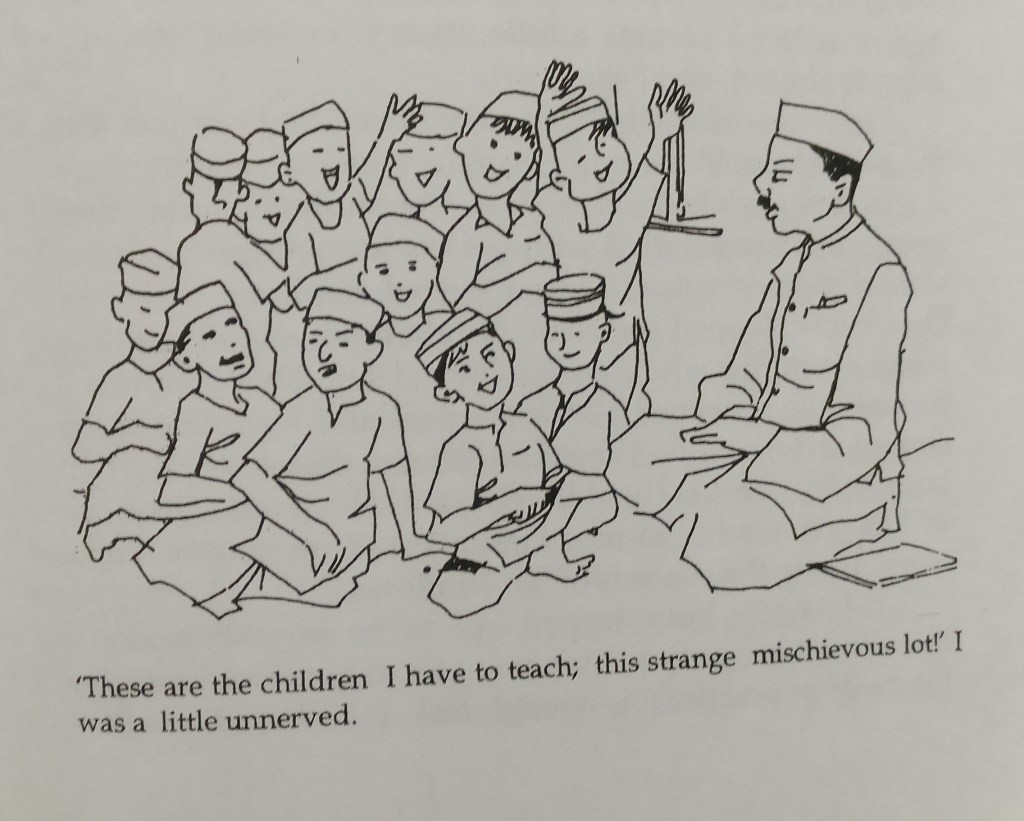
Gijubhai’s Divasvapna is the story of a teacher who succeeds in making innovative experiments in the classroom. In the true spirit of the book’s title the teacher daydreams of igniting a fire for learning in the students. And he works hard to turn the dream into reality. His one year journey in the classroom was not a cakewalk though.
First day when he entered the class, he was full of energy and enthusiasm. He had been allotted class IV by the headmaster. The teacher had come prepared with the activities for the day. He knew the students were used to a lot of noise and disorder in the school. He should give them the practice of remaining silent. Let them savour the joy of silence. His first activity, thus, was a game of silence.
As he entered the class, he explained everything about the game. That the game would begin with the teacher’s uttering the words, Om Shanti. After that everyone in the class would become silent. All the doors, windows would be closed. The classroom would be dark. There would be a complete silence in the class. The teacher had expected that the students would get a new experience from the game. They would get an opportunity to listen to the sounds outside.
But the students had some other plans. Why would they listen to the instructions of a new teacher, specially the one who was polite and soft? They were used to loud instructions, corporal punishments etc. None of them paid attention to him. Instead they became noisy and mischievous. Some of them made catcalls, others were clapping, laughing, repeating the words, ‘Om shanti’ in a tone of mockery. The teacher was completely at a loss. He couldn’t do what other teachers or even the headmaster expected him to do, that is give corporal punishment to the students. It would have been against the very idea of education for which he had joined the school.
Unable to understand what to do next the teacher gave them the day off from the school, much before the school was to get over. When the headmaster came to know about this, he was angry. He reprimanded the teacher and asked him to stop making such experiments in the school.
The teacher had failed on the very first day in the class. He was very disappointed.
What should the teacher do the next day? Should he use the same game, the same strategy or he should make some changes? Should be be harsh with the students, as suggested by the headmaster and the other teachers? Let’s know about all these in the next episode.
I too dislike it: there are things that are important beyond all this fiddle. Reading it, however, with a perfect contemp for it, one discovers in it after all, a place for the genuine. Hands that can grasp, eyes that can dilate, hair that can rise…..
This is an extract from a poem on Poetry by Marianne Moore. She begins with the disclaimer ‘I too dislike it’. Her aim is to take the readers into confidence at the outset. And then to tell them how one gets something genuine in poetry, how reading a poem can be exciting and joyful.
This ‘genuine’ that Moore refers to is the truth of life a poet seeks to express in a poem. The poet is the articulate and the reader is the inarticulate part of that process. However the joy factor is not less important than the ‘genuine’ in Poetry.
Moore knew that poetry is difficult to understand. It is concentrated, full of associations and images. It is also subject to interpretations. Still she encourages the readers to enter the difficult terrain of poetry. She assures them that despite the difficulties, reading poetry can be rewarding. The complete poem is available here.
Why to evaluate
One should begin reading poetry for enjoyment, and not for evaluation. Acquiring the tools of evaluation at the initial stage is like putting the cart before the horse. But it is also true that the process of evaluation begins with the choice of our first poem. Otherwise we wouldn’t say that we like this poem more than that. Or X poet is my favourite. Our choices also change with age. In childhood we like nursery rhymes more but as we grow older we prefer poems with deeper meanings.
It is true that too much analysis could lead to a loss of enjoyment. But some knowledge about the important aspects of poetry can surely help us understand and enjoy it better. A good way to acquire the knowledge and a critical sense would be to read poetry for enjoyment and to reflect while one reads. One can pick up the tools for evaluation as one delves deeper.
Content & Form
What is the poet trying to convey and how does he do that? These are the two questions that can reveal the two important aspects of Poetry: Content and Form. Content refers to the world view or the theme of a poem. And its types are as many as the variety of life itself. Still content of poetry can broadly be classified into themes like Doubt & Faith, Life & Death, Love, Grief, Nature, Society etc. Form is the outer appearance of the poem that includes rhythm, rhyme, poetic devices, structure, length etc.
In an essay on The Criticism of Poetry, James Reeves says ‘content determines form and form modifies content’. According to him both are inseparable in a poem. While composing a poem a poet doesn’t work on the content first and then on the form or vice versa. Both happen simultaneously. Reeves cites the example of Alexander Pope, the most celebrated poet of the 18th century, to reveal how the rigidity of form puts restrictions on the content of Pope’s poetry. Heroic Couplet was Pope’s favourite and probably it was required for the content that he sought to create. He was ‘laying down the laws of thought and conduct in the polite society of his time. In one of his well known poems, An Essay on Criticism, Pope uses the following Heroic couplet to express:
Good nature and good sense must ever join; To err is human, to forgive, divine.
Fifty years after Pope’s death Wordsworth and Coleridge set new norms for a new age called Romantic Age of English Poetry. This was also the period of French Revolution when all over Europe the ideas of Freedom and Equality were taking shape. Wordsworth and Coleridge collaborated to produce a manifesto for this new school of Poetry through their book of poems called Lyrical Ballads. Their range of content had widened and also the range of their form. James Reeves says, ‘The novel ideas which he (Wordsworth) had to express in his poems could not be expressed in stereotyped forms. Nature was an integral part of Wordsworth’s poetry. The following lines have been taken from his two different poems:
Come forth into the light of things, Let Nature be your teacher. — The Tables Turned
I listened, motionless and still; And, as I mounted up the hill, The music in my heart I bore, Long after it was heard no more. — The Solitary Reaper
Great poets are known for the experiments they make both with content and form. One of the leading American poets of twentieth century, E E Cummings, is known for several experiments in Poetry. An extract from his poem, [as freedom is a breakfastfood], below reveals how he did away with punctuation marks in his poems:
as freedom is a breakfastfood or truth can live with right and wrong or molehills are from mountains made — long enough and just so long will being pay the rent of seem and genius please the talentgang and water most encourage flame
Cummings is known also for many of his shape poems.
In modern Hindi poetry Suryakant Tripathy Nirala is well-known for his experiments. His poems, भिक्षुक or तोड़ती पत्थर are pathbreaking both in terms of content and form. He must be the first to have chosen a beggar or a woman worker as the subject of his beautiful poems, creating a new convention of using the deprived section of the society as the theme of his poems. He was also the pioneer of free verse in Hindi poetry.
वह आता–
दो टूक कलेजे को करता, पछताता
पथ पर आता।
— भिक्षुक
वह तोड़ती पत्थर
देखा मैंने उसे इलाहाबाद के पथ पर
— वह तोड़ती पत्थर
Nirala is followed by several other contemporary poets like Muktibodh, Nagarjun, Kedarnath Singh, Alok Dhanwa in Hindi poetry who broke the existing boundaries of content and form.
Poetry & civilization
A civilization is measured by the greatness of the poets associated with that. Elizabethan period in England, the periods of Guptas, Harsha, Akbar in India or Tang dynasty in China are known for the poets and other artists who were active during those times. Poetry used to be an essential part of social life during Tang dynasty. In order to be eligible for their civil services exams it was necessary for the candidates to be the masters of Poetry.
Great poems are those that stand the test of time. People don’t get tired of reading them even after hundreds or thousands of years. The poems of Kalidasa, Tulsidas, Kabir, Rahim, Subramaniam Bharti in Indian literature or those of Homer, Virgil, Chaucer or Shakespeare in European literatures and several others in Chinese, Japanese, Persian, Arabic have entertained and inspired the mankind for years together. They will continue to do so in the years to come.
Poets are gods
A contemporary Indian poet, Ashok Bajpei, says in a recent interview that poets are gods. Their work is to create works of art for posterity. God is known to be the greatest Creator. Bajpei says that through this process of creation the poets become one with god. One can certainly perceive a tone of arrogance in his statement.
But a similar sentiment can be observed in the following lines of a Shakespearean sonnet:
Not marble nor gilded monuments Of princes shall outlive this powerful rhyme — Sonnet no 55
Shakespeare composed this sonnet to immortalise his love for a friend. He says that war, death, or time can destroy the magnificent monuments built in the memory of princes, kings but nothing can erase the words that I create to celebrate my love. They will remain forever. He was so prophetic. Even after five hundred years, I and a large number of English teachers were teaching this poem in CBSE schools until recently, thousands of kilometers away from the place of Shakespeare’s birth.
A stanza from Longfellow’s A Psalm of Life is also relevant in this context:
Lives of great men all remind us We can make our lives sublime, And, departing, leave behind us Footprints on the sands of time




 Arupedia
